Please click here to view slideshow in a larger screen.

Jun 15, 2008


Jun 5, 2008
The Ghats Must Be Crazy

 Our wooden boat slowly maneuvered through the masses of worshippers. There were those that floated, those that lathered, those that splashed, and those that prayed. It was 5:30 AM and the sun was slowly making its ascent over the Ganges River in Varanasi, India. It is considered one of the oldest cities in the world and certainly one of the holiest. Indians from across the country make their pilgrimage to the ghats that line 7km of the river. These ghats consist of stairs descending into the cleansing waters of the Ganges. They are a continuous carnival of tourists, touts and spiritual rituals. On these steps, at any given moment, you can find people washing their cows, washing their clothes, cutting their hair, selling flowers, cremating family members, playing cricket, meditating, roller skating, sleeping, eating, having a shave, dancing, or just sitting back and enjoying the sights, smells, and sounds. It is the absolute epitome of the chaotic Indian culture, all conveniently occurring simultaneously on the miles of steps, platforms, and temples that lines the shoreline in Varanasi.
 As our driver continued to row, narrowly avoiding the heads of those cleansing their souls, Amanda and I watched in awe. Of course, all of this activity gives the city a magical air. It is a place of life and death. It is a place where one can witness the entire cycle of life while floating in a boat rowed by a teenager. Parents wash their newborns. The elderly rinse their pains away. The mourning say their prayers. The truly religious ring their bells and wave their flames in a nightly service thanking the Ganges for its devine power. The crematory sits on the banks as well. We passed through it often. At any hour in the day and night you will find families ritualistically burning the bodies of those they love. As their ashes join the floating candles in the river, the Hindu cycle of life and death is broken, sending their souls to a final resting place.
 My fingers nervously flip through my phrase book as our boat approaches a group of men squatting on the rocks drinking down the holy water from their cup-shaped hands. I want to explain to them that this holiest of holy waters is also the dirtiest. Unfortunately I am unable to find the words I want. The phrase was conveniently excluded from the pages of my guide. The Ganges River here contains over 3000 times the safe amount of faecal coliform bacteria. It is literally septic, meaning it contains no dissolved oxygen. Over 30 sewage pipes deposit directly into this nearly still river. These facts only add (considerably) to the spectacle that occurs here daily. Over 60,000 people, whether ignoring these facts or ignorant to them, happily let the filthy water surround their bodies and cleanse their souls.
 We spent our three days wandering through the mazes of streets and chaos. It is hardcore India culture to the max.
Jun 1, 2008
Eating India
As we sit down at the small Ram Raja Restaurant in the town of Orchha, a man herds his fifteen water buffalo over the adjacent bridge for a refreshing bath. The sign for the restaurant proudly reads: “Recommended by Lonely Planet”. The traveler’s bible is omnipresent. We glance at the small menu where nothing costs much more than $1. A family of about 10 noisily awakes themselves in the morning hours behind the curtain separating the street from the kitchen. We finally decide to order: Shak Shuka, an egg dish with cabbage and onions, toast and chai tea. Five minutes later a man emerges from the curtain, starts his Honda bike and motors off. After a few more moments a young boy runs towards the market, 20 rupees in hand. The tea arrives after only ten minutes. The Indians love their Masala Tea. Known as Chai to us westerners, it’s the perfect blend of spice, milk, and sugar, served in a tall glass. As we sip tea two SUV’s packed with one family arrives. They file out and head towards the restaurant. Their shotgun-armed bodyguard looking like a drunken frat boy who spent the night binge drinking follows them. They sit in a half circle of chairs in the street staring at Amanda and I center stage at our raised table.
They stare, talk about us in Hindi, and stare some more. Their tea comes out and they sip it and stare. Awkward. Finally the father convinces his son to talk to us.
“Hello, from what country?”
“USA” we reply, “Where are you from?”
“I am twelve, you my home like?”
“What?” this conversation isn’t going too far. “Is this your family?” We warily continue.
“Yes, my father, 4 sisters, uncle, two brothers, drunken, shotgun-wielding driver.” The conversation is back on track.
Just then the man on the motorcycle returns with a crate full of vegetables. We ordered 30 minutes ago and the ingredients have just arrived. At least we know they’re fresh.
The family returns to their stares and we return to our Lonely Planet. While traveling, meal times are always a great time to plan your next move. A few minutes later the other boy returns from the market with no cabbage. His father, not too pleased, sends him running back from where he came. Then a twelve year old boy emerges from the kitchen speaking perfect English to us. His brother went to buy cabbage for our meal he explains. We smile and order more tea. Then about 8 young kids run off the street through the curtain. Two minutes later, 4 different children emerge and run down the street.
The large family stands up, pays, and wanders up the road. Their body guard, who has been stroking his shotgun for the past half hour, puts it in the truck and sits back down. Families only need guarding while they’re eating.
There is a constant flow of tractors pulling water tanks. They return from the river full and cross the bridge empty. The electricity goes out, killing the Indian music and giving us a sudden silence. It is rare that electricity does not go out in most cities around here. After about 70 minutes I finally get antsy and ask the man who went to the market if the boy returned with the cabbage yet. He smiles, nods and slips behind the curtain. Twenty seconds later he returns with our meals. We devour it, taking note to avoid the butter with dead mosquitoes in it. It is delicious but there is no cabbage. We pay our bill: $2.38, and pray to the Ganesh poster on the wall that we won’t spend the next three hours in the bathroom. It’s now 8:30 AM and India is waking up. Nothing is ever as it seems in India. It truly rewards those with patience.

After breakfast we hired our guide (pictured left, photo by leighton) for the rest of India. He's not very good with the train schedules but he always leads us to the good restaurants.
May 31, 2008
The Taj Mahal


How do you describe a shot of tequila? It burns as it first enters your system. Then, you feel the warmth coming from within. You beg for more. It’s funny how the same words can be used to describe India. At first we were overwhelmed by a city of more than 15 million. At first we were disheartened by all of the people pushing their products – often lying to make a sale. At first, the crowds of men huddled outside a restaurant like a pack of starving dogs waiting for scraps was appalling. Then, suddenly the warmth comes through. We see past the bad and into the good. The people are warm and friendly, the culture is well preserved, and the chaos has become quite comfortable after only a few days.
After wandering for a day through Delhi, the most overwhelming city in the world, we headed south by train to Agra, home of the Taj Mahal. This is possibly the most photogenic structure ever erected by man. Its perfect symmetry and raised foundation give it a surreal appearance, not to mention the white marble that shines as bright as the day it was completed. We spent four hours looking at the Taj from every possible angle.
We are now in the small town of Khajuraho. We spent the morning strolling through the ancient Jain temples here that feature thousands of Kama Sutra carvings. It’s hot , it’s crazy, it’s India.


May 25, 2008
We've Been Published part 2
In today's Tucson daily newspaper, the Arizona Daily Star, we had another article published! click on this link to read it. http://www.azstarnet.com/accent/240463
May 24, 2008
Kaup Chai Laos
 After Luang Probang we spent a few nights in the backpacker city of Vang Vieng. Imagine a city set in the midst of beautiful limestone karsts and rivers. Fishermen cast their nets from their long river boats. Locals cross bamboo bridges to their island homes. Dozens of restaurants blast every season of “Friends” from multiple TVs all hours of the day. Every hangout is packed with tourists who waste their day sipping “happy” shakes and watching Joey and Rachel and the rest of their Friends get out of some crazy situations. It was not exactly our idea of paradise. We then bussed it to Vientiane, the Laos capital. Here we rented a 1967 Vespa to cruise the town. It was a fitting end to this peaceful country.
 It is said that Laos is the most bombed country in the world. Between 1971 and 1973, it became helplessly involved in the largest bombing raid in US history as the North Vietnames sheltered their soldiers across the border in Laos. In these 2 years, more bombs fell in Laos than were dropped during all of WWII.
Yet, in spite of all this destruction, today they are a wonderful people who have begun to embrace capitalism and open their borders to investment and tourism. We loved Laos and give it an enthusiastic two thumbs up.
May 20, 2008
Laos
 It’s quite humorous that I find Laos to be such an amazing country. After all life has not gone so smoothly for me since our small plane barely landed on the tarmac of the dark airport. The trouble began as I sat in the head customs agent’s office. After paying an extra dollar for my Visa because our plane landed after hours, it was pointed out to me that my passport has less than 6 months of validity left on it. Apparently I am the only world traveler that did not get this memo. I should never have a passport in this state of existence. It is nearly worthless in most countries. Lucky for us a little cash will do the trick - $120 and my meaningless identification had yet another entry stamp emblazoned in its tattered pages.
Luang Probang, in Northern Laos is referred to in our Lonely Planet guide book as the “prettiest city in Asia” This might be true. However, it has also fallen ill to the “Lonely Planet” curse. All of us loyal followers adhere to its words with the voracity to descend like the swarm of adventure-hungry independent traveling locusts that we are, destroying every town, hotel, and restaurant whose name is so fortunate to find it’s way onto the pages of the tattered Lonely Planet bible that rests clutched in the hand of every other tourist who passes. With one finger stuck in the page where a small map of the town resides, we hand over our hard earned cash in abundance, raising prices and crowding the streets with our own kind. Unfortunately, this is the exact thing we have traveled around the globe to avoid. Ahh but not all is lost. Luang Probang is simply too wonderful to be destroyed by the $800 scarves that sit on the shelves of boutique stores and the $40 French restaurants nestled between two $1 noodle soup shops. It is a town teeming with young monks who reside at its more than thirty temples. They march through the streets at 6 am collecting alms for the day from shop owners. Their mere existence is a constant reminder of the country we are visiting, - as if the beautifully colorful tuk-tuks weren’t evidence enough that this was indeed not Kansas.
It’s not so much that 23 people were crammed into the back of a truck on a journey north that bothered me. It was not the sweltering heat. The frequent and jolting stops and uncomfortable seat did not rattle me. It was not even the motorcycle that leaned on its kickstand mid-ship in the truck dripping gasoline on my foot that simply has no other spot the rest but beneath its engine. None of these things disturbed me. What nearly brought me to tears was having not a clue how long the journey would last, and that the guy next to me was smoking.  Eventually we reached our destination. The beautiful city of Nong Khiaw’s small write- up in our “Lonely Planet” has spared it. A town must have a map in the guide book before the curse sets in. The swarm must know where to sleep. We lulled the day away reading from the hammocks in our private Sunrise Guesthouse bungalow ($5/night) perched high above the Nam Ou River. Massive Limestone cliffs dripping in lush jungle rose on all sides. Kids played soccer on a small island that surfaces only when the water is low. Ridiculously long river boats motored locals and tourists alike up and down stream.
So far it sounds pretty good doesn’t it? There’s just one hiccup in this story. That’s true. Then there was the fall. We had been hiking through the thick jungle, around freshly scorched rice fields, between thatch houses on stilts, and among the amiable water buffalo for three hours. We stopped every five minutes to pick leaches from our ankles. I had been telling the German in front of me about the amazing durability and usefulness of bamboo. “Did you know that pound for pound, bamboo has twice the tensile strength of steel? It is the fastest growing plant in the world – ten cm a month! It is used in Chinese scaffolding Michael! It is used in concrete as a cheap alternative to rebar! It is a truly renewable building material. You can eat it! It is godlike!” Most of these words fell from my mouth in the moments leading up to the bridge.
I never expected to fall off a bridge in the thick Jungle of Laos. Then again I never expected three sticks of such a wonderful material to give way beneath my weight, depositing me into the river below. I was not scared. Mid-air, as my arms both attempted to roll up imaginary car windows I did not think about the fact that we were thousands of miles from a Western hospital. I did not wonder if I would be hurt. I did not worry that we were three hours by foot from the nearest road. In this moment of clarity, all that passed through my head was the fact that the bamboo had failed me. I felt used.
Of course I was fine. I sat in the muck in shock for 5 seconds while my five trekking partners, Amanda included, ran to my aid. I escaped with a small scratch and nothing more.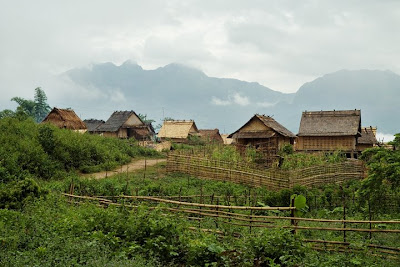 Strike two for Laos. But I still love it. The people are amazing. The food is wonderful and the terrain absolutely surreal. I keep expecting a red Jeep to drive by with a T-Rex in close pursuit. Our hike finally brought us to the small village of Phayong. As you stroll down its dirt paths and watch the children throw chickens at each other, it is difficult to know what century it is. Under one of the 40 stilted houses a woman crushes corn with a foot powered mill. Next door, a topless woman holds her new-born slung across her back as she watches her chickens eat from an old basket of feed. Down the street, a man tends to the ten beautiful pineapples growing inside his bamboo fence. Laos is wonderful. This particular village sees about 10 tourists every month. We slept in the home of the Village Chief. For dinner and lunch we chewed on rice and green beans. Breakfast mixed it up a bit with rice and bamboo. Amanda couldn’t believe what she was seeing. She became a vestige of her lens as it pulled her toward every corner of the village. The shutter never rested more the a few seconds.
 And this has been Laos. We are headed towards Vientiane, the capital, so I can replace my passport. I’m hoping I don’t receive a third strike in this country because it is really great. No one wants to see Sammy Sosa strike out. It’s just not right.
Subscribe to:
Posts (Atom)